


When people talk about a “good” hair transplant, they’re usually talking about density. It means how full and natural the hair looks when everything has healed. But density is about much more than simply placing as many grafts as possible into a thinning area. Achieving natural fullness depends on something far more important: surgical precision in planning, harvesting, and placing every single graft.
What Does Transplant Density Really Mean?
In Hair Restoration Raleigh NC, density refers to how many follicular units (grafts) are placed per square centimeter of scalp. While aiming for 35–50 grafts/cm² is a common benchmark for a natural look, this number is almost meaningless without context.
Trying to push beyond safe density limits can actually backfire. If grafts are packed too tightly, the blood supply is compromised and fewer grafts survive, which means the final result can look thinner than planned despite higher numbers on paper.
Why Precision Matters More Than Graft Count
High-quality hair transplant density is not just a numbers game. It depends on how carefully each follicular unit is handled and how strategically it’s implanted. Skilled hair transplant surgeons focus on:
- Angle and direction – Grafts must be placed at a natural angle and direction, or the hair will stick out unnaturally.
- Depth control – Slits that are too deep or too shallow can lead to complications like graft “popping,” poor growth, or visible surface irregularities.
- Spacing between grafts – Enough space is needed to preserve blood flow so each graft can survive and grow, especially in high-density zones.
- Matching natural patterns – The hairline, crown whorl, and mid-scalp all grow in different patterns and must be recreated carefully for a believable result.
This technical precision is what transforms raw graft numbers into a thick, natural-looking hair transplant rather than a patchy or “pluggy” result.
Planning Hair Density
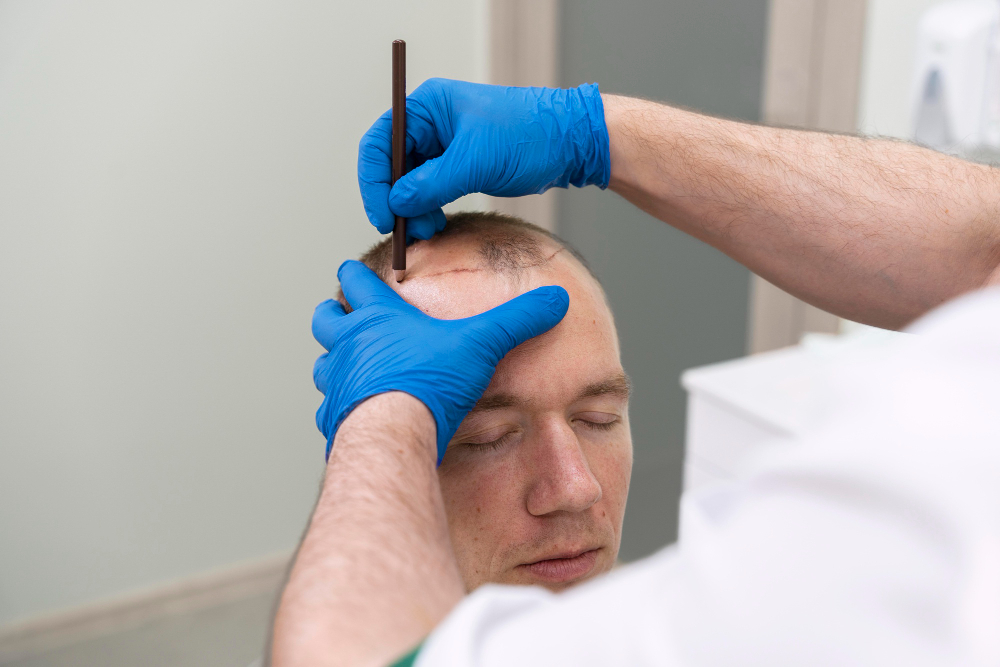
Before any graft is harvested, a precise plan is created. During consultation at JIYA Cosmetics, Dr. Sumeet Jindal evaluates:
- Donor hair density and quality
- Hair shaft thickness and texture
- Color contrast between hair and scalp
- Current pattern and likely future pattern of hair loss
- Goals for frontal hairline, mid-scalp, and crown
Because the donor area is finite, responsible planning often targets densities that create the illusion of fullness rather than trying to match childhood density one-for-one.
How Technique and Technology Support Better Density
- FUE (Follicular Unit Extraction) allows individual follicles to be harvested and implanted with fine control over angle, depth, and direction.
- FUT (strip method) can provide a larger number of grafts in one session for patients needing more coverage, especially in the mid-scalp or crown, when performed with meticulous closure and graft handling.
- Newer technologies like robotic systems can enhance the consistency of extraction and placement, helping surgeons achieve uniform density and more predictable results.
In all of these methods, surgical precision plays a key role in reducing trauma to both the donor and recipient areas. It also supports higher graft survival rates and more visible density over time.
Choosing a Precision-Focused Hair Transplant
For patients considering a best hair transplant doctors in Raleigh, surgical precision is one of the most important factors to evaluate. Dr. Sumeet Jindal’s background in facial and hair surgery, allows him to prioritize careful planning, gentle graft handling, and meticulous placement for truly natural density. Call us at (919) 929-6006 to schedule a consultation.
