

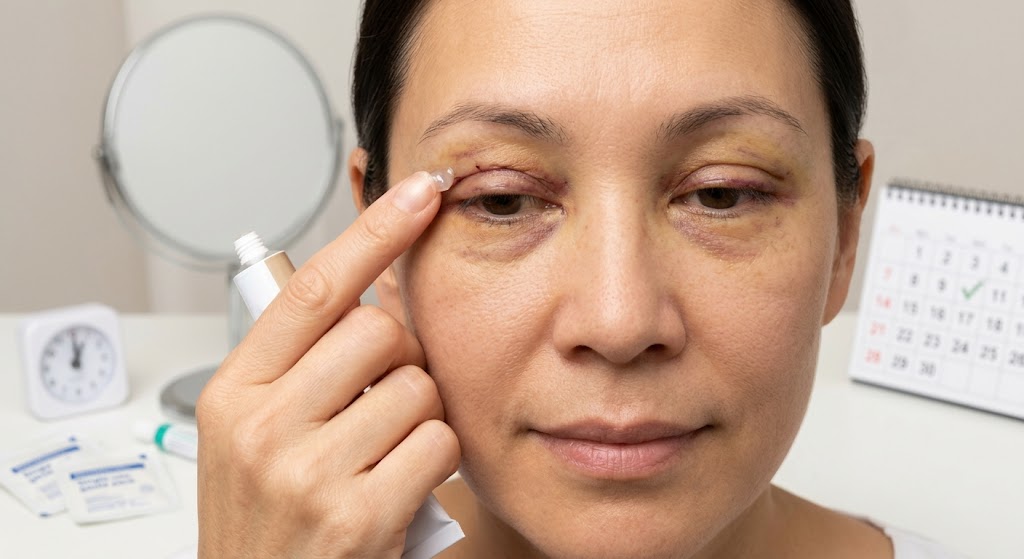
After blepharoplasty, it is normal to have questions about healing and aftercare. Many patients wonder how long to use the ointment, when the swelling will begin to settle, or when it is safe to return to their usual eye creams and skincare products. Because the eyelid skin is thin and delicate, even small changes during recovery can feel more noticeable.
- Why Ointment Matters After Eyelid Surgery?
- The exact duration depends on:
- Application Guidelines
- When Can I Use Eye Cream After Blepharoplasty?
- Can You Use Neosporin on Eyelids?
- Day-by-Day Blepharoplasty Raleigh, NC Recovery Timeline
- What’s Normal vs. What Requires Immediate Attention After Eyelid Surgery
- How to Choose Right Surgeon for Blepharoplasty in Raleigh, NC
- Advanced Recovery Support After Blepharoplasty Raleigh, NC
- Expert Advice from Dr. Sumeet Jindal
- Ready to Take the First Step?
Taking care of your eyelids after surgery is an important part of the healing process. During the first few days, the ointment helps keep the incision area protected and comfortable while preventing the delicate skin from becoming too dry or irritated as it heals.
Patients considering blepharoplasty Raleigh NC, often want results that look refreshed without changing the natural character of their eyes. At JIYA Cosmetic, Dr. Sumeet Jindal, a board-certified ophthalmologist and fellowship-trained oculofacial cosmetic surgeon, focuses on eyelid procedures designed to preserve natural eye shape while improving heaviness, puffiness, and excess skin around the eyes.
This guide explains how long to use ointment after blepharoplasty, what the normal healing timeline looks like, and when patients can safely return to regular eye creams.
Why Ointment Matters After Eyelid Surgery?
According to the American Society of Plastic Surgeons, over 325,000 blepharoplasty procedures are performed annually in the United States, making it one of the top five cosmetic surgeries.
After blepharoplasty, your incisions are vulnerable.
- Infection prevention: The thin antibiotic layer blocks bacteria from entering fresh surgical sites.
- Moisture retention: Keeping incisions from drying out prevents premature scabbing, which can widen scars.
- Tissue protection: A barrier shields delicate healing skin from irritants, friction, and environmental exposure.
How Long to Use Ointment After Blepharoplasty?
The exact duration depends on:
- Incision closure rate: Once the edges seal completely, ointment becomes unnecessary
- Suture type: Dissolvable sutures may extend the timeline slightly
- Individual healing speed: Factors like age, skin type, and immune response vary
- Your surgeon’s protocol: Some prefer conservative 10-day guidelines; others adjust based on visual assessment
Application Guidelines
- Days 1–3: Apply a thin layer 3–4 times daily to incision sites
- Days 4–7: Reduce to 2–3 times daily as swelling decreases
- Days 8–14: Continue only if incisions remain raw or the surgeon advises
- After Day 14: Stop unless specifically instructed otherwise
When Can I Use Eye Cream After Blepharoplasty?
Earliest safe point: 2–4 weeks post-surgery. Before reintroducing cosmetic eye cream, confirm:
- Incisions are fully closed with no openings
- All scabs naturally shed (don’t pick them off)
- No redness, tenderness, or discharge
- Surgeon approval at follow-up appointment
Why Waiting Matters
Eye creams contain fragrances, retinoids, peptides, and active ingredients designed for mature skin, not healing surgical wounds. Applying them too early triggers:
- Contact dermatitis
- Hyperpigmentation along incision lines
- Delayed wound closure
- Increased scarring risk
Best Eye Cream After Blepharoplasty: Choosing Wisely
After blepharoplasty, the skin around the eyes can feel dry, tight, or sensitive as it heals. The safest approach is to use gentle, fragrance-free eye creams that support hydration without irritating the delicate eyelid area.
Once cleared by your surgeon, choose products with these characteristics:
- Fragrance-free formulations: Artificial scents irritate healing tissue
- Hypoallergenic certification: Reduces allergic reaction risk
- Gentle hydration ingredients: Hyaluronic acid, ceramides, squalane
- No active exfoliants: Avoid retinol, AHAs, and vitamin C for the first 6 weeks
During the healing phase, it is best to avoid harsh active ingredients, strong fragrances, or heavy products unless your surgeon recommends them. Keeping the area calm and well moisturized is usually more important than using aggressive skincare treatments early in recovery.
Can You Use Neosporin on Eyelids?
Generally not recommended unless your surgeon specifically prescribes it.
Reactions near the eyes manifest as:
- Swelling
- Intense itching
- Red, weeping rash
- Prolonged inflammation
Bacitracin or erythromycin is recommended by surgeons for eyelid surgery due to their lower rates of allergy, yet sufficient antibiotic potency. One should not use any OTC products instead.
Day-by-Day Blepharoplasty Raleigh, NC Recovery Timeline
Anticipation of events helps reduce stress during recovery. Healing is usually a structured process, but individual differences are entirely expected.
Days 1–2: Eyes look swollen, taut, and sore. Ice packs work well; use them carefully for 10–15 minutes hourly while you are awake. Discoloration is due to bruising that looks purplish or red. The ointment can be started right away; apply it 3 or 4 times a day to the incision lines.
Days 3–5: Crusting begins to form along the incision lines, but these crusts actually help protect the healing area. Blurry vision due to the ointment is a temporary effect.
Days 5–10: Incisions begin to heal as the edges turn from raw skin into light pink lines. Most people see a 40% to 50% reduction in swelling by day seven. Ointment treatments can be reduced to twice a day, as directed by your surgeon.
Weeks 3–4: Eye cream reintroduction becomes possible once your surgeon confirms complete incision closure. Scar softening begins as incision lines gradually lighten from pink to pale.
Months 2–3: Scars flatten noticeably and become significantly easier to conceal. Most people around you won’t notice them unless you point them out.
Months 6–12: Many scars fade to faint lines that blend naturally into the eyelid crease. This is when final results truly emerge; what you see in the mirror now reflects the outcome you’ll carry forward.
What’s Normal vs. What Requires Immediate Attention After Eyelid Surgery
There will be unfamiliar sensations. They might appear frightening, yet they are very natural. Others may seem like nothing serious when in reality, they require immediate attention.
Normal Recovery Signs You Should Look for:
- Mild itching around incisions: This actually signals good news. Itching indicates nerve regeneration as your body repairs disrupted pathways. It typically begins around days 3 to 5 and resolves within 2 weeks. Resist the urge to scratch; cold compresses and a prescribed ointment provide relief.
- Tightness around your eyes: Your eyelids may feel like they don’t quite belong to you. This stretched, snug sensation is normal as tissues adjust to their new contours. It gradually softens over several weeks as swelling resolves and skin relaxes.
- Light sensitivity for 2–3 weeks: Bright lights may feel uncomfortable or cause squinting. Your eyes are simply more vulnerable during the healing process. Wear sunglasses outdoors and reduce screen brightness indoors until sensitivity fades.
- Asymmetrical swelling: One eye puffier than the other? Completely normal. Faces aren’t perfectly symmetrical, and neither is healing. One side often swells more or resolves faster.
- Watery eyes or minor discharge: Clear or slightly blood-tinged drainage in small amounts signals normal fluid movement. Gently dab with clean gauze rather than rubbing.
Red Flags Requiring Urgent Care
Contact your surgeon immediately if you experience any of these warning signs:
- Severe pain unrelieved by prescribed medication:
- Pus or yellow-green discharge from incisions
- Vision changes beyond expected blurriness
- Fever above 100.4°F (38°C)
- Worsening redness after initial improvement
- Rapid swelling after initial reduction
According to the American Academy of Ophthalmology notes blepharoplasty can improve both eyelid appearance and functional concerns caused by excess skin.
How to Choose Right Surgeon for Blepharoplasty in Raleigh, NC
Interest in blepharoplasty has continued to grow across the Raleigh area as more patients look for natural ways to refresh tired or heavy-looking eyes.
At JIYA Cosmetic, patients seeking blepharoplasty are treated by Dr. Sumeet Jindal, whose background combines ophthalmology, microsurgery, and cosmetic eyelid surgery. His training focuses not only on appearance but also on preserving the eyes’ natural function and structure.
Many patients in Raleigh are not trying to completely change their appearance. Most simply want their eyes to appear less tired, heavy, or puffy while still looking like themselves. At Jiya Cosmetic, every treatment plan is customized to the individual, focusing on subtle improvements that preserve the natural shape and expression of the eyes.
Advanced Recovery Support After Blepharoplasty Raleigh, NC
Healing after eyelid surgery is not only about the procedure itself. The way your skin recovers, how swelling settles, and how your tissues respond during the weeks after surgery also play an important role in the final result.
Most patients heal well with routine aftercare alone, but some also look into additional support options during recovery. Through Jiya Cosmetic’s associated care network, patients may explore PRP-based regenerative therapies designed to support the body’s natural healing process and tissue recovery after aesthetic treatments.
These therapies are not required for blepharoplasty recovery, but some patients choose to learn about them as part of a more comprehensive approach to skin and tissue wellness.
During your consultation, Dr. Sumeet Jindal focuses on creating a recovery plan tailored to your individual needs, healing patterns, and surgical goals rather than recommending the same approach for every patient.
Expert Advice from Dr. Sumeet Jindal
Recovery after blepharoplasty is not the same for everyone. According to Dr. Sumeet Jindal, that difference often comes down to individual factors such as skin quality, muscle strength, healing response, age, and the natural structure of the eyes.
That is why following your surgeon’s instructions closely is so important after eyelid surgery. Simple things like how you sleep, when you return to exercise, how you care for the incision area, and how you manage swelling can all affect the healing process and outcome.
At JIYA Cosmetic, Dr. Sumeet Jindal takes a safety-first approach for blepharoplasty in Raleigh NC. Rather than removing excessive skin or creating an overdone appearance, the focus is on preserving natural eyelid function while achieving a refreshed, balanced look. His background in ophthalmology allows him to evaluate more than just cosmetic concerns. He also considers blinking function, eyelid support, tear film health, and overall eye comfort before recommending surgery.
This level of evaluation is especially important for patients with ptosis, dry eyes, previous eyelid surgery, or vision-related concerns. Instead of using the same surgical plan for every patient, Dr. Jindal customizes treatment based on each person’s anatomy and healing needs.
Ready to Take the First Step?
Walk into many cosmetic practices, and you’ll get a standardized treatment plan. At JIYA Cosmetic, Dr. Sumeet Jindal takes a different approach.
Ready to explore Blepharoplasty Raleigh, NC? Schedule your personalized consultation or call JIYA Cosmetic at (919) 929-6006 or visit jiyacosmetic.com with us.
FAQs
How long do I apply ointment after blepharoplasty?
Typically 5–14 days, depending on incision closure and surgeon instructions. Most patients stop around day 10.
Can I stop the ointment early if healing looks good?
No. Surface appearance doesn’t reflect deeper tissue repair. To continue until your surgeon confirms discontinuation.
When can I wash my face normally?
Gentle cleansing around the eyes begins on day 3–5. Full normal washing resumes after suture removal (usually day 7–10).
Is itching normal after eyelid surgery?
Yes. Mild itching signals nerve regeneration. Severe itching with rash suggests an allergy; contact your surgeon.
Can I wear makeup after blepharoplasty?
Avoid eye makeup until incisions fully close (typically 2 weeks minimum). Concealer on the surrounding areas is usually acceptable after day 7 with the surgeon’s approval.