


Table of Contents
- The Complexity of Corrective Eyelid Surgery
- What is Canthoplasty Revision Surgery?
- Indications for Canthoplasty Revision
- What is Canthopexy Revision Surgery?
- Canthopexy vs Canthoplasty Revision: Which Do You Need?
- The Role of Spacer Grafts in Revision Surgery
- Surgical Procedure Explained
- Recovery Timeline and Expectations
- Why Choose Dr. Jindal for Revision Surgery?
- Cost of Canthopexy & Canthoplasty Revision in Raleigh, NC
- Frequently Asked Questions
Correcting the results of a previous eye surgery requires a significantly higher level of surgical skill and anatomical knowledge than a primary procedure. Patients who have undergone unsuccessful eyelid surgery often face a difficult combination of functional issues, physical discomfort, and aesthetic dissatisfaction.
Dr. Sumeet Jindal is a leading expert in eyelid revision surgery, specifically focusing on canthopexy and canthoplasty revision surgery in Raleigh, NC. Whether you are suffering from complications due to a botched cosmetic procedure or trauma, our goal is to restore the natural shape of the eye, protect your vision, and help you regain your confidence.
The Complexity of Corrective Eyelid Surgery
Eyelid surgery, medically known as blepharoplasty, is a delicate balance between removing excess tissue and tightening the support structures. Complications arise when the support structures at the outer corner of the eye, specifically the lateral canthal tendon, are not adequately secured, or if the healing process leads to excessive internal scarring.
Revision canthoplasty and revision canthopexy are reconstructive procedures designed to fix these complications. Unlike primary surgeries, which focus on enhancement, revision surgeries focus on restoration and reconstruction. This often involves navigating through scar tissue, replacing missing tissue with grafts, and re-establishing the structural integrity of the eyelid margin.
Why Do Primary Surgeries Fail?
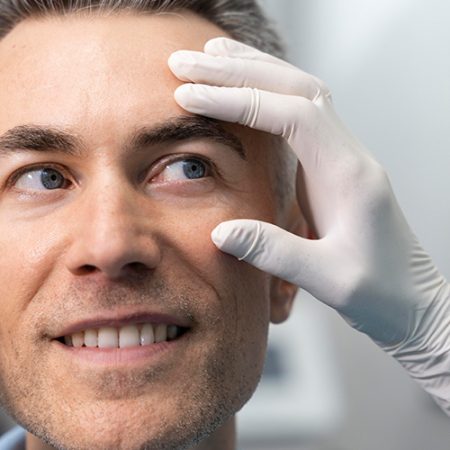
Understanding why your first surgery failed is the first step toward fixing it. Failures in lower eyelid surgery often stem from:
- Aggressive Tissue Removal: Removing too much skin or muscle can pull the eyelid downward, a condition known as vertical shortening.
- Poor Anchor Placement: If the canthal tendon is anchored too low or too shallow during canthopexy, gravity will eventually pull the lid down again.
- Scarring (Cicatricial Forces): Internal scarring can tether the eyelid layers, creating downward traction that distorts the eye shape.
- Neglected Midface Ptosis: If a heavy, sagging cheek is pulling on the eyelid and was not addressed, the eyelid repair will likely fail under the weight.
Dr. Jindal corrects these anatomical issues by reconstructing the eyelid’s support system from the bone upward.
What is Canthoplasty Revision Surgery?
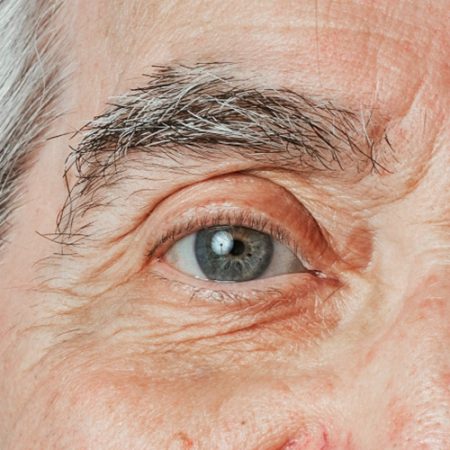
Canthoplasty revision surgery is a reconstructive procedure used to correct significant malposition of the lower eyelids. It is the most effective solution for patients dealing with “round eye syndrome” or ectropion (outward turning eyelid) following a previous blepharoplasty.
This procedure involves surgically detaching the lateral canthal tendon, releasing it from scar tissue, and re-anchoring it securely to the orbital rim. In many revision cases, simple tightening is not enough. Dr. Jindal may need to employ advanced techniques to lengthen the eyelid or provide rigid fixation.
The Drill Hole Technique
In complex canthoplasty revision cases, the soft tissue (periosteum) typically used to anchor sutures may be weak or damaged from the earlier surgery. To ensure a permanent fix, Dr. Jindal uses a drill-hole technique. Two small, precise holes are drilled into the bony rim of the eye socket. The tendon or graft is then threaded through these holes. This provides a reliable fixation point that does not rely solely on soft-tissue adhesion, significantly reducing the risk of recurrence.
Indications for Canthoplasty Revision
- Scleral Show: Visible white space below the iris.
- Ectropion: The lower lid pulls away from the eye, causing dryness and irritation.
- Rounding of the Canthus: The sharp, almond-shaped outer corner has become blunted or rounded.
- Lagophthalmos: Inability to close the eyes completely, leading to exposure keratopathy.
What is Canthopexy Revision Surgery?
Canthopexy revision surgery is less invasive than full canthoplasty. It is generally indicated for milder complications. A primary canthopexy involves suturing the tendon without cutting or detaching it. If these sutures break, dissolve too early, or are not anchored securely, the eyelid will return to a lax state.
Patients requiring revision canthopexy usually notice a recurrence of mild drooping or “basset hound” eyes shortly after their initial procedure. The goal of canthopexy revision surgery is to reinforce the outer corner again, using permanent suture materials or a different anchoring vector to ensure longevity.
Indications for Canthopexy Revision
- Recurrent Laxity: The eyelid feels loose again shortly after surgery.
- Mild Asymmetry: One eye sits slightly lower than the other.
- Prevention: Reinforcing the lid during a revision of lower blepharoplasty to prevent future retraction.

Canthopexy vs Canthoplasty Revision: Which Do You Need?
The choice between revision canthoplasty and revision canthopexy is determined by the severity of the deformity and the elasticity of the eyelid.
- Revision Canthoplasty: Required when the shape of the eye is distorted (round eye), or the tendon has been physically detached or damaged. It is a reconstructive necessity for ectropion.
- Revision Canthopexy: Ideal for patients with a natural eye shape but a lack of tightness. It is a supportive procedure rather than a reconstructive one.
During your consultation at Jiya Cosmetics, Dr. Jindal will perform the “snap-back” and “distraction” tests to quantify your eyelid laxity and determine the appropriate surgical plan.
The Role of Spacer Grafts in Revision Surgery
In many canthoplasty revision surgery cases, the lower eyelid is vertically short because skin or muscle was removed in the previous surgery. Simply pulling the lid up to the bone would make it impossible to close the eye. To resolve this, Dr. Jindal must reinsert the tissue into the eyelid. This is done using a spacer graft.
A spacer graft acts like a structural strut. It pushes the lower eyelid rim upward, fighting against the retraction caused by scar tissue. Common materials used for spacer grafts include:
- Hard Palate Graft: Harvested from the roof of the patient’s mouth. This is the gold standard as it provides a mucous membrane lining that is comfortable against the eyeball.
- Ear Cartilage: Harvested from the back of the ear. It provides excellent stiffness for support.
- Alloderm (Cadaveric Dermis): A sterile, processed tissue matrix that avoids the need for harvesting from a second site on the patient’s body.
Incorporating a spacer graft increases the complexity of the eyelid revision surgery but is often the only way to achieve a safe, natural-looking result in severe cases.
Surgical Procedure Explained
Dr. Jindal performs these procedures at the Jindal Institute for Youthful Aeging, an accredited surgical facility in Raleigh, NC. We prioritize patient safety and comfort throughout the process.
Preparation and Anesthesia
Most revision canthoplasty and revision canthopexy procedures are performed under local anesthesia with deep sedation (MAC anesthesia). This ensures you are asleep and comfortable while avoiding the heavy aftereffects of general anesthesia.
Step 1: Mobilization
Dr. Jindal makes an incision, often utilizing the previous scar line to avoid creating new marks. He carefully dissects the lower eyelid to release it from the underlying scar tissue (cicatrix) tethering it.
Step 2: Reconstruction (Canthoplasty) or Plication (Canthopexy)
- For Canthoplasty Revision: The tendon is identified and reconstructed. If a drill hole is needed, it is created at this stage. If a spacer graft is required, it is sutured between the lower eyelid retractors and the tarsus.
- For Canthopexy Revision: Permanent sutures are placed through the existing tendon and anchored high on the orbital rim periosteum.
Step 3: Midface Recruitment
If the cheek is sagging, Dr. Jindal may perform a sub-orbicularis oculi fat (SOOF) lift. This lifts the heavy cheek tissue and suspends it to the orbital rim, taking the weight off the newly repaired eyelid.
Step 4: Closure
The incisions are closed with fine sutures. Dr. Jindal uses meticulous techniques to ensure the skin edges align precisely, minimizing scarring.
Recovery Timeline and Expectations
Recovery from eyelid revision surgery is typically longer and more complex than recovery from primary surgery. Patients must be prepared for the healing process.
Immediate Post-Op (Days 1-3)
You will experience swelling, bruising, and tightness. Your eyes may look “cat-like” or slanted upwards. This is intentional. Dr. Jindal overcorrects the eyelid position to account for the natural drop that occurs as gravity acts on the healing tissues. Do not be alarmed by this initial appearance.
The First Two Weeks
Sutures are typically removed between days 7 and 10. Bruising will fade to yellow. You may experience chemosis (swelling of the clear covering of the eye), which appears as a jelly-like blister. This is common in revisions due to disrupted lymphatic drainage. We provide steroid drops and lubricants to manage this.
Long-Term Healing (Months 1-6)
The “cat-eye” look will settle as the tissues relax. The scar tissue will soften. While you can return to social activities within 2 to 3 weeks, the final results of a canthoplasty revision are typically seen at the 3 to 6-month mark.
Why Choose Dr. Jindal for Revision Surgery?
Selecting a surgeon for revision canthoplasty is a critical decision. This is not a procedure for a general cosmetic surgeon. It requires an oculoplastic specialist who understands the intricate mechanics of the blink reflex, the tear film, and orbital anatomy.
Dr. Sumeet Jindal has dedicated his practice to facial and ocular aesthetics. His approach to eyelid revision surgery combines reconstructive precision with aesthetic artistry.
- Specialized Expertise: Dr. Jindal focuses specifically on the eyes and face.
- Revision Experience: A significant portion of our practice is dedicated to correcting complications from other facilities.
- Patient-Centric Care: We believe in honest communication. We will tell you realistically what can be achieved and what cannot.
Cost of Canthopexy & Canthoplasty Revision in Raleigh, NC
The cost of canthoplasty revision is generally higher than that of primary surgery. This reflects the increased surgical time, the technical difficulty, and the potential need for grafts or implants.
Factors influencing the price include:
- Surgical Complexity: Whether grafts (hard palate, ear cartilage) are needed.
- Anesthesia Fees: Based on the duration of the surgery.
- Facility Fees: Our state-of-the-art surgical suite ensures hospital-grade safety.
- Combined Procedures: If a midface lift or brow lift is performed simultaneously.
At Jiya Cosmetics, we provide a transparent fee structure during your consultation. We do not believe in hidden costs. If your condition causes functional problems like corneal exposure or chronic tearing, a portion of the eyelid revision surgery may be reimbursable by medical insurance. Our team will assist you in determining your coverage eligibility.
Frequently Asked Questions
What is the difference between revision canthoplasty and revision canthopexy?
Revision canthoplasty involves cutting and reconstructing the tendon to shorten and support the eyelid. It is used for major shape correction. Revision canthopexy uses sutures to tighten the existing tendon without cutting it and is used for mild laxity reinforcement.
How long must I wait after my first surgery to get a revision?
We generally recommend waiting at least 6 months after the primary surgery. This allows all swelling to subside and scar tissue to mature. Operating on inflamed or immature scar tissue can lead to unpredictable results and further complications.
Can revision surgery fix "round eye" syndrome?
Yes. Canthoplasty revision surgery is the gold standard for correcting the round eye shape caused by previous lower blepharoplasty. By releasing the scar tissue and lifting the outer corner, the natural almond shape can be restored.
Will I have visible scars?
Dr. Jindal places incisions in the natural creases of the eyelids or utilizes previous incision lines to minimize new scarring. While all surgery leaves scars, they are designed to be inconspicuous once healed.
What is Chemosis, and will I get it?
Chemosis is swelling of the conjunctiva (the white part of the eye). It is very common after revision canthoplasty because the lymphatic channels are temporarily disrupted. It is temporary and treated with lubrication and time.
Is the surgery painful?
Patients are under anesthesia during the procedure and feel no pain. Post-operative discomfort is manageable with prescribed medication and cold compresses. The donor site for a hard palate graft (if used) may be sore for a few days, similar to a “pizza burn.”
Can I wear contact lenses after surgery?
You should avoid wearing contact lenses for at least 3 to 4 weeks after eyelid revision surgery to avoid pulling on the eyelid and to allow the chemosis to resolve.
Does Dr. Jindal treat patients from outside Raleigh?
Yes, we welcome patients from Durham, Chapel Hill, Cary, and beyond. For out-of-town patients seeking revision canthopexy or canthoplasty, we can coordinate virtual preliminary consultations.
Restore Your Eyes, Restore Your Confidence
Living with the results of a botched eyelid surgery is physically and emotionally draining. You do not have to accept discomfort, tearing, or dissatisfaction as your permanent reality. There are solutions available.
Dr. Jindal and the team at Jiya Cosmetics are here to help you navigate the path to restoration. We combine advanced surgical techniques with compassionate care to deliver results that look natural and function perfectly.
Take the first step toward correcting your vision and appearance.
Contact Jiya Cosmetics in Raleigh, NC today to schedule your comprehensive consultation.