

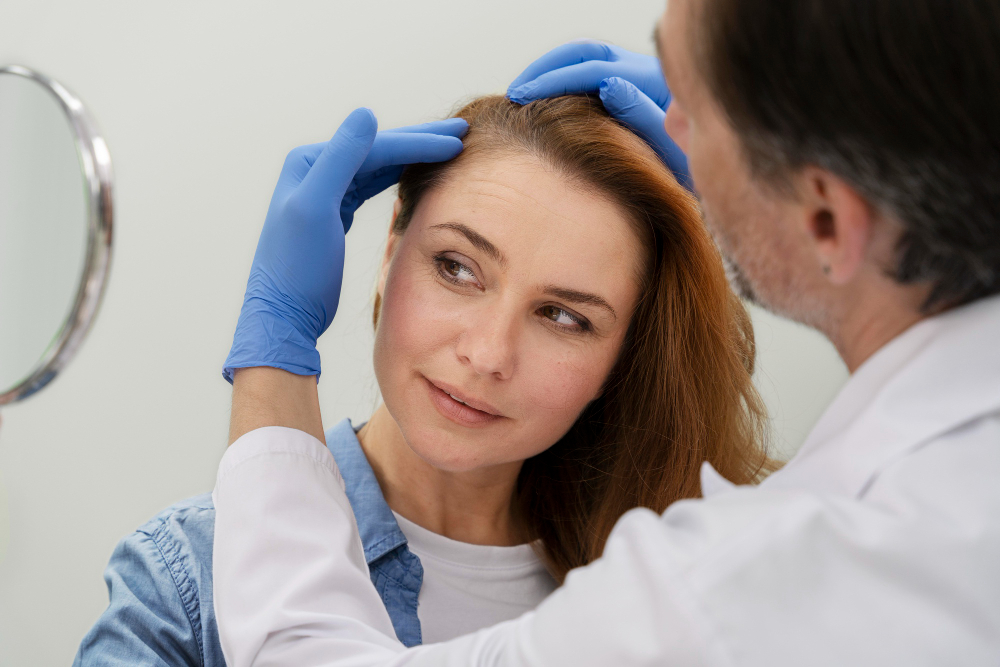
Hair loss is often talked about as a men’s issue, but a significant proportion of women experience hair thinning during their lives, which can feel just as distressing. While many people assume hair transplants are designed only for male-pattern baldness, modern techniques allow women to benefit from surgical hair restoration as well. The key difference is that female hair loss behaves differently than male hair loss. It means the evaluation, planning, and surgical approach must be tailored to women’s unique needs.
- Why Women Experience Hair Thinning and Hair Loss
- Can Women Get Hair Transplants?
- How Female Hair Transplants Differ from Male Procedures
- The Female Hair Transplant Process
- Best Candidates for Female Hair Transplant Surgery
- When Hair Transplants Aren’t the Best Option
- Is Female Hair Restoration Worth It?
- Explore Your Transplant Options in Raleigh, NC
Wondering whether a hair transplant could help restore your confidence and your hairline? Here’s everything you need to know about how female hair restoration works and how it differs from male procedures.
Why Women Experience Hair Thinning and Hair Loss
Female hair loss is influenced by a combination of genetics, hormones, aging, and lifestyle factors. The most common type, female-pattern hair loss (FPHL), typically appears as:
- A widening part
- Diffuse thinning across the top or crown
- Reduced overall density
- Thinner ponytails or hair that feels less full
- More scalp showing under bright light
Unlike men, who often develop distinct balding areas, women usually maintain their frontal hairline but experience widespread thinning.
Additional triggers may include:
- Postpartum hormonal changes
- Menopause
- Thyroid disorders
- Iron deficiency
- Chronic stress
- Certain medications
- Autoimmune conditions
Female-pattern hair loss causes diffuse thinning at the top of the scalp and widening of the part line, a condition described in detail by the American Academy of Dermatology.
Because female hair loss has multiple potential causes, a thorough medical evaluation is essential before considering surgical treatment.
Can Women Get Hair Transplants?
Yes, women can absolutely get hair transplants. According to the International Society of Hair Restoration Surgery, hair transplantation can be a viable treatment option for women whose hair loss is due to hereditary pattern thinning. The key is determining whether the patient has stable donor hair that is not affected by ongoing thinning.
Women who may benefit from a hair transplant include those with:
- Female-pattern hair loss in a predictable pattern
- Thinning or a widening part
- Traction alopecia from long-term hairstyles
- Hairline recession from aging
- Bald spots related to scars or injuries
- Over-plucked eyebrows that no longer grow in
When designed carefully, a transplant can restore density, rebuild a natural hairline, and dramatically improve volume.
ALSO READ: Cristiano Ronaldo Hair Transplant: Hair Transformation Facts Explained
How Female Hair Transplants Differ from Male Procedures
Although the core techniques, including FUE (Follicular Unit Extraction) and FUT (Strip Method), are the same, the approach and goals differ significantly in women. Experts note that male and female hair loss differ in progression and pattern, often requiring tailored surgical approaches for women.
1. Hair Loss Pattern
- Men often lose hair in defined areas (temples, crown, hairline).
- Women tend to lose hair diffusely over the top of the scalp, which requires a strategic, blended pattern of graft placement.
2. Donor Site Evaluation
Women must have strong, stable donor hair that is not thinning. In men, the donor zone is easier to assess because male-pattern baldness spares the sides and back more predictably.
3. Maintaining Long Hair for Coverage
Women often do not shave their heads for surgery. Surgeons use long-hair FUE techniques so the transplanted area remains discreet during healing.
4. Natural Female Hairline Design
Female hairlines are softer, more rounded, and less linear than men’s. Restoring or reinforcing a woman’s hairline requires artistic attention to:
- Subtle curves
- Irregularity for realism
- Natural density patterns
5. Addressing Hormonal Causes of Hair Loss
Because hormones play a major role in women’s thinning, hair transplants are often combined with medical treatments. This combination helps protect existing hair and maintain transplant results.
The Female Hair Transplant Process
While every patient’s plan is customized, most procedures follow these steps:
1. Consultation and Diagnosis
A provider evaluates hair density, pattern of loss, scalp health, and donor zone strength. Bloodwork or hormonal testing may be recommended.
2. Designing the Plan
Female restoration often involves:
- Strengthening the mid-scalp
- Narrowing a widening part
- Enhancing density around the hairline
- Treating areas of traction alopecia
3. Graft Harvesting
Using FUE or FUT, tiny follicular units are harvested from the donor region, often without shaving the entire area.
4. Graft Placement
Transplanted hairs are placed to blend seamlessly with existing hair using meticulous angles and spacing.
5. Growth Timeline
- Initial shedding in the first month
- Early regrowth begins around 3–4 months
- Noticeable improvements at 6–9 months
- Full results at 12–18 months
Best Candidates for Female Hair Transplant Surgery
Women may be good candidates if they have:
- Stable hair loss rather than rapid shedding
- A strong, healthy donor area
- Realistic expectations
- Thinning concentrated in specific areas
- Hair loss not caused by uncontrolled medical conditions
Those with diffuse unpatterned alopecia (DUPA) may not be candidates because donor hairs may be unstable.
When Hair Transplants Aren’t the Best Option
Certain conditions respond better to medical therapy rather than surgery, including:
- Telogen effluvium (stress or postpartum shedding)
- Thyroid-related thinning
- Autoimmune alopecia (like alopecia areata)
- Nutritional deficiencies
- Medication-induced shedding
In these cases, a transplant would not correct the underlying cause, and non-surgical treatment is recommended first.
Is Female Hair Restoration Worth It?
For the right candidate, yes. Female hair transplant can restore fullness, rebuild confidence, and create natural-looking improvements that grow with your own hair. Because women’s hair loss patterns are more nuanced, choosing a specialist experienced in female restoration is crucial for achieving the most harmonious outcome.
Explore Your Transplant Options in Raleigh, NC
If you’re noticing thinning, a widening part, or changes in density, you’re not alone, and you have options. At JIYA Cosmetic , Dr. Sumeet Jindal diagnoses and treats female hair loss with personalized surgical and non-surgical solutions tailored to your needs. He understands the unique patterns of female hair restoration and designs each treatment plan to achieve natural, seamless results. Call us at (919) 929-6006 to book a consultation.