
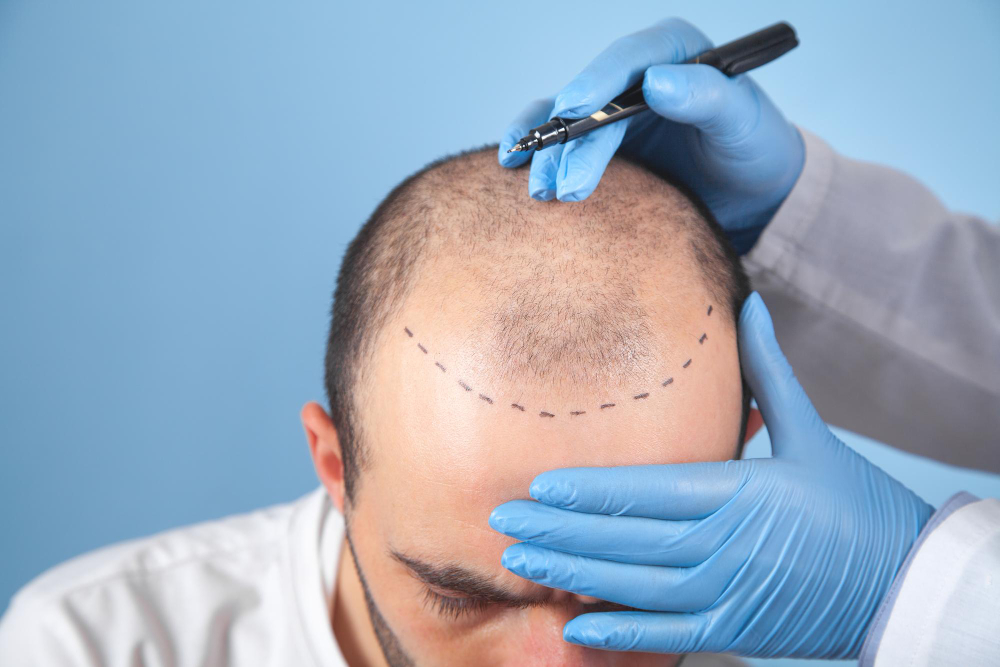
When you start noticing your hairline creeping back or your crown looking thinner in every photo, it’s normal to Google every hair restoration method out there, and end up more confused than when you started. JIYA Eyelid and Facial Cosmetic Surgery + Hair Restoration offers the full spectrum of modern hair transplant options – NeoGraft® FUE, manual FUE, ARTAS® robotic FUE, and FUT strip surgery. All of these methods move your own hair follicles from a permanent donor zone (usually the back of the scalp) into thinning areas. The main difference is how those grafts are harvested and implanted, and how that impacts scarring, recovery, and styling freedom. Let’s learn more about it.
FUT (Strip) Hair Transplant: The Classic Workhorse
How it works
In Follicular Unit Transplantation (FUT), Dr. Jindal removes a narrow strip of scalp from the back of your head, then the team dissects it into tiny follicular units and implants them into balding areas.
Pros
- Efficient way to move a large number of grafts in one session
- Often cost-effective per graft
- Excellent long-term density when performed by an experienced surgeon
Cons
- Leaves a linear scar where the strip was taken (though usually hidden by surrounding hair)
- Less ideal if you like very short fades or buzz cuts
- Slightly longer healing in the donor area
FUT can still be a great choice for patients who prioritize maximum graft numbers and don’t mind a well-hidden strip scar. At JIYA, it’s one of several options on the menu, never the only option.
FUE: Sutureless Harvesting, No Linear Scar
Follicular Unit Extraction (FUE) takes a different approach: instead of removing a strip, the surgeon uses tiny circular punches, often less than 1 mm wide, to extract individual follicular units directly from the donor area.
Pros
- No long linear scar; instead you have tiny dot scars that are usually hard to see, even with shorter hairstyles.
- Minimally invasive and sutureless.
- Popular for patients who want to wear their hair short or are especially scar-conscious.
Cons
- Technically demanding and time-intensive in purely manual form.
- Requires trimming/shaving the donor area.
- May not be ideal for patients who need very large numbers of grafts in a single sitting.
At JIYA, Dr. Jindal uses advanced FUE techniques and devices, then chooses between manual FUE, NeoGraft®, or ARTAS® based on your goals, hair type, and how many grafts you need.
NeoGraft® FUE: Advanced, Automated FUE
NeoGraft Hair Transplant is an automated FUE system JIYA uses to make graft harvesting faster and more consistent compared to fully manual FUE.
NeoGraft®:
- Uses an automated handheld device with pneumatic (gentle suction) technology to harvest follicular units one by one from the donor zone.
- Avoids a scalpel and stitches, so there’s no linear strip scar.
- Allows follicles to be extracted in their naturally occurring groups of one to three hairs, then re-implanted where you’re thinning.
Benefits highlighted at JIYA’s NeoGraft page:
- Natural-looking hairlines and density.
- Super safe, minimally invasive, with quick recovery.
- Typically no visible scarring, so you can comfortably wear shorter hairstyles.
For many men and women with pattern hair loss who want a faster recovery and minimal downtime, NeoGraft® provides a strong balance of efficiency, comfort, and cosmetic outcome.
ARTAS® Robotic FUE: AI-Guided Precision
If NeoGraft® is advanced, ARTAS® Robotic Hair Restoration is the ultra-high-tech option. JIYA was the first practice in Raleigh to bring ARTAS® robotic FUE to the area.
ARTAS® uses:
- AI-driven cameras to analyze your donor hair in real time.
- A robotic arm to select and harvest the strongest grafts thousands of times per session.
- Image-guided planning to help create and implant a personalized, natural-looking hairline.
Key benefits at JIYA:
- Minimally invasive, no strip and no linear scar.
- Highly consistent graft quality and spacing.
- Short recovery, many patients resume normal activities in 1–2 days.
- Permanent results using your own hair, with a very natural look when combined with Dr. Jindal’s hairline design expertise.
ARTAS® is often ideal for patients who want cutting-edge technology, large high-density sessions, and the most meticulous donor management possible.
Which Technique Is Right for You?
There’s no single best method for everyone. Instead, JIYA looks at:
- Your hairstyle goals
- Love fades and short back-and-sides? FUE, NeoGraft®, or ARTAS® typically wins.
- Comfortable with a hidden linear scar if it means more grafts? FUT may still be an option.
- Love fades and short back-and-sides? FUE, NeoGraft®, or ARTAS® typically wins.
- How many grafts you need
- Moderate areas: FUE, NeoGraft®, or ARTAS® often give excellent coverage.
- Very large areas: FUT or ARTAS®/NeoGraft® planned over staged sessions, depending on donor supply.
- Moderate areas: FUE, NeoGraft®, or ARTAS® often give excellent coverage.
- Downtime and lifestyle
- Need to be back at work quickly? Minimally invasive FUE options (NeoGraft® or ARTAS®) have especially fast recovery at JIYA. If recovery time is a major factor in your decision, see our breakdown of the FUE vs FUT hair transplant recovery timeline to understand which option heals faster.
- Overall plan for your hair
JIYA doesn’t just offer surgery; the team also uses PRP/PRF, nanofat stem cell restoration, Keravive scalp therapy, and scalp micropigmentation to support graft survival and long-term density.
Hair Restoration with a Long-View Strategy at JIYA
Choosing between Hair Transplant NeoGraft in Raleigh, FUE, FUT, and ARTAS® isn’t just about a gadget, it’s about designing a strategy that respects your donor supply, your age, your pattern of loss, and the way you actually like to wear your hair.
At the Jindal Institute for Youthful Aging in Raleigh, NC, board-certified facial cosmetic and microsurgeon Dr. Sumeet Jindal evaluates your scalp, hair characteristics, and goals, then recommends the mix of technology, FUT, FUE, NeoGraft®, ARTAS®, and regenerative support, that makes the most sense for youlong-term.
If you’re ready to move past hiding your hair loss and toward a permanent, natural-looking solution, JIYA can help you choose the hair restoration technology that truly fits your life, not just today but years from now. Call us at 919-929-6006 or write to us via contact form.